Economics Research at WBDC
The beef economist at Western Beef Development Center has been responsible for conducting an annual cow-calf cost of production benchmarking study. The economist's duties also include conducting economic analysis on the research projects carried out at Termuende Research Ranch by Dr. Bart Lardner and his research students and associates.
Economic Analysis of Applied Research
For every research study carried out at Termuende Research Ranch there is the question: “What did it cost?” For example, in addition to studying the effects of feeding pregnant beef cows crop residues and wheat DDGS (dried distillers’ grain and solubles) supplementation WBDC also determines the cost (e.g. $/hd/day) to feed crop residues and DDGS as a winter feed ration. Producers are keenly interested in the economics behind WBDC’s research projects as they are unwillingly to adopt a new practice if it does not make economic sense.
Detailed record keeping by WBDC Research Technician, Leah Pearce, and graduate students is key to being able to conduct economic analysis. Actual prices (i.e. purchased feedstuffs, crop inputs) are used as much as possible, but published averages are also used for some parts of the analysis. For examples, projects involving crop production may use custom rates from Saskatchewan Ministry of Agriculture’s Farm Machinery and Custom Rental Rate Guide but efforts are made to use the actual rate paid to WBDC's custom operators.
The Saskatchewan Ministry of Agriculture and the Canada-Saskatchewan Growing Forward bi-lateral agreement through the Agriculture Development Fund (ADF) have provided funding to the Western Beef Development Centre to develop of a producer-friendly cost of production tool.
WBDC greatly appreciates the funding support from ADF for this much needed tool.
Cost of Production Calculator
Replacement Heifer Calculator
Disclaimer: These calculators are provided without warranty on an "as-is" basis. WBDC (a Division of PAMI) assumes no liability or responsibility with respect to loss or damage caused by or alleged to be caused by the use of these calculators.
Cow-Calf Cost of Production (COP)
Why Calculate COP?
It has been said, “you cannot manage what you do not measure”. Determining cost of production is a great way for a cow-calf producer to gauge their operation’s financial sustainability. Cost of production analysis can actually be completed for all the enterprises on your ranch - cow-calf, replacements, backgrounders, grassers, hay, pasture, etc. This is known as whole-ranch analysis. It is important to calculate cost of production for all your enterprises in order to determine where the ranch is making money and where it is losing money.
Typically cow-calf cost of production is reported as dollars per cow wintered ($/cow wintered), however, dividing costs by the total pounds of calf weaned yields the unit cost of production or break-even price on calves. Your unit cost of production can be compared with posted market prices.
While Western Beef's benchmark prices can offer a glimpse into cow-calf cost of production in Saskatchewan, there is actually a lot of variation between operations. Therefore, it is much more valuable for a producer to take the time and use their own production and financial information to calculate their own cost of production
What information is needed?
Both production and financial information is required for calculating cost of production. Financial information comes from accounting records and production information will come from herd records. The first year a rancher calculates their cost of production is usually the most difficult due to the unfamilliarity of the process.
For each enterprise on the ranch, there is different information required. The table below shows the data required for five typical enterprises on a ranch.
WBDC and COP Going Forward
In the past, Western Beef would collect a rancher's production and financial information, perform the analysis using a program called CowProfit$ and provide back cost of production summaries for each of the ranch's enterprises (i.e., cow-calf, replacements, backgrounders, hay, pasture, etc). There was a lag associated with this analysis. First, WBDC had to wait for producers to wean their calves. In Saskatchewan, spring calving herds weaned in the fall. Second, WBDC had to wait for producers' accounting years to end (which is still December 31st for many producers). February through April was the typical timeframe to collect ranch data for the previous year's calf crop, which meant some ranches may already been into their next year's calving period.
Cow-calf ranchers are increasingly more comfortable with computers and using software programs to track financial and production information. The interest by producers to have a tool to use at home for cost of production has been understood.
An Excel-based tool has been developed by WBDC's economist Kathy Larson for producers to use at home. Below you will find an Excel tool that can be used to enter your own information, throughout the Excel tool are helpful hints to guide the data entry process. There is also a populated example for a made up ranch called ABC Ranch to show how the data can be entered into the tool. All links are above.
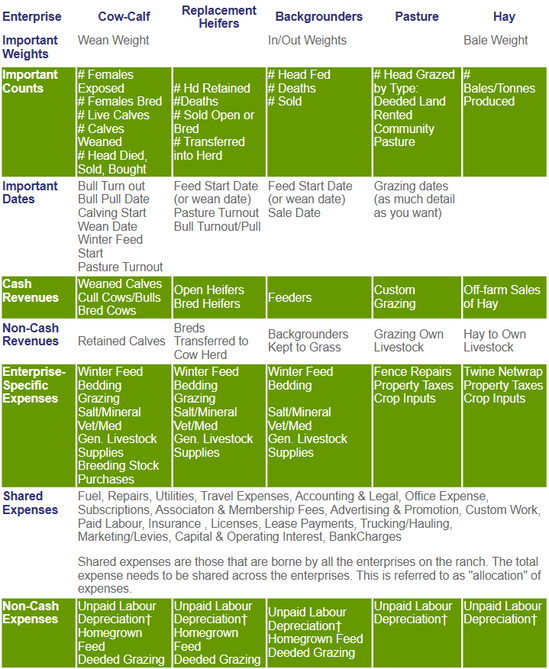
† Depreciation is a percentage of the current value of assets (machinery, buildings, livestock equipment). In the same way expenses are allocated across enterprises, assets need to be allocated to the enterprises that utilize the asset.